
Bee Gathering
Kate Keohane, Art Historian
On 29 May 2026, I hosted an online meeting, a joint initiative of Beeing Together and Art Hx, that brought together artists, beekeepers, farmers, researchers and organisers. Each was invited to bring an image and to speak about a concern, a dream, or an idea not yet realised. The texts that follow grew out of those contributions.
Bees have been moving between flowers for tens of millions of years, far longer than there have been people to watch them. Of the twenty thousand or so known species, most live alone, nesting in soil, hollow stems and dead wood; only a few form the large colonies we often imagine. Their lives are woven with those of plants, trees, fungi and weather.
Evidencing the intersections between climate-change and colonialism, from the seventeenth century, European honeybees were shipped to the Americas to "improve" colonised land, arriving among native bees, such as the Melipona of the Yucatán, and among the peoples who had tended them for millennia.
Beekeeping, in turn, is a practice of close and continuous attention. To keep bees is to read the seasons, to listen to the pitch of the hive, and to intervene cautiously when needed. It is also an exercise of control. The word "keeping" implies ownership, and commercial apiculture is bound up with industrial agriculture. For the contributors here, beekeeping carries both of these histories. It can be a livelihood and a technical craft, a form of therapy and a spiritual discipline, a means of sustaining community under pressure. Knowledge passes between keepers, and between bees and people, across and beyond any single tradition.
The thinker Katherine McKittrick offers a route through these entanglements. For her, the bee is an anti-colonial figure: an ancient and planetary insect whose rhythms are not those of colonial time. Her book, Twenty Dreams (2024), made with designer Cristian Ordóñez, thinks race, environment, place and blackness in relation, alongside the hand-bent wire bees of Charmaine Lurch, one of our contributors. McKittrick calls these bees "an expression of expansive and unfinished relationalities", lessons that leave room for wonder. We offer this collection in the same spirit.
The collectives and individuals who took part in this conversation show how varied such collaboration can be. Some convene through ceremony. At the Mayan Melipona Bee Project, the land, the cosmos and the bees are asked for permission before a hive is placed, so every assembly includes more than humans; in Yucatec Maya, kab means both bee and world. Others organise through horizontal networks: They Keep Bees and its collaborators across the northeastern United States meet in a kitchen as often as in an apiary. Some bond through making. The cob Chula at Bees & Refugees was built by people who return to the site for company and for therapeutic purposes. Others bear witness. Comb Cutters and Soul Fire Farm host testimonies from Palestine, Emilia Beatriz records oral histories of grief after Hurricane María, and Sarah Khan photographs farmers and learns from their ways of being with place. Some connections are a matter of breath. Midway through our session, Emilia asked everyone to breathe and buzz, and a screen of separate Zoomed rooms moved towards a shared vibration.
The artists here work at the hive's thresholds. Their methods are slow and interdisciplinary, grown from conversations with gardeners, scientists and crofters, or from years of study alongside land workers. Charmaine bends wire into wild bees whose woven porosity lets the eye pass through to the world beyond, so that each sculpture contains an inside and an outside at once. Oreet Ashery, of Beeing Together, treats a clay stove as a social sculpture. She also turns an edge-detection algorithm against its intended purpose, so that filmed footage of the boundaries between Ali Alzein of Bees & Refugees, the bees, the trees, and the sky flicker and blur. Emilia Beatriz works with clay, wax, honey and propolis, in partnership with bees, earth and compost worms, to imagine what absence tastes, smells and feels like. Jennifer Lauren Martin lays metallic black carpenter bees over a photograph taken as a love was ending, and addresses the viewer through a series of open questions. What the artists offer are modes of sensing communal life: porosity, frequency, grief and desire, and a willingness to stay with what cannot be fully known.
We, as a gathering, are wary of idealising any of this. Bees themselves know community to be ambivalent. A cluster finds its form through relationship alone, but when a hive is under threat, workers can "ball": pressing tightly to generate a heat that suffocates what they surround. Togetherness can shelter, and it can smother. Any collective, then, must also protect what is not shared.
What is at stake in bringing these voices into dialogue is the insistence that aesthetic, technical, spiritual and political knowledges belong in the same room. Instrumental insemination, ceremony, wirework and mutual aid are all forms of knowing bees. Doing so also means facing the question Ali Alzein asks of his own work, which we ask of ours: how do we build something that heals without extracting? Rebecca of Comb Cutters offers one answer in propolis. Bees borrow this resin from trees to shield the whole hive, creating a social immunity in which responsibility is shared so that no one carries its full weight alone.
The contributors write from Miami, Nagaland, the Yucatán, the West Bank, Puerto Rico, Glasgow, Canada, Marseille, England and the northeastern United States. Together they reflect upon what it means to keep bees, and to hold and tend to one another, under extraction, siege and displacement, and they challenge what has come to be accepted as normal.
These texts are not conclusions. Read them in any order, the way you might approach a hive: attentively, slowly, with care and sensitivity to the edges.
Charmaine Lurch, Artist
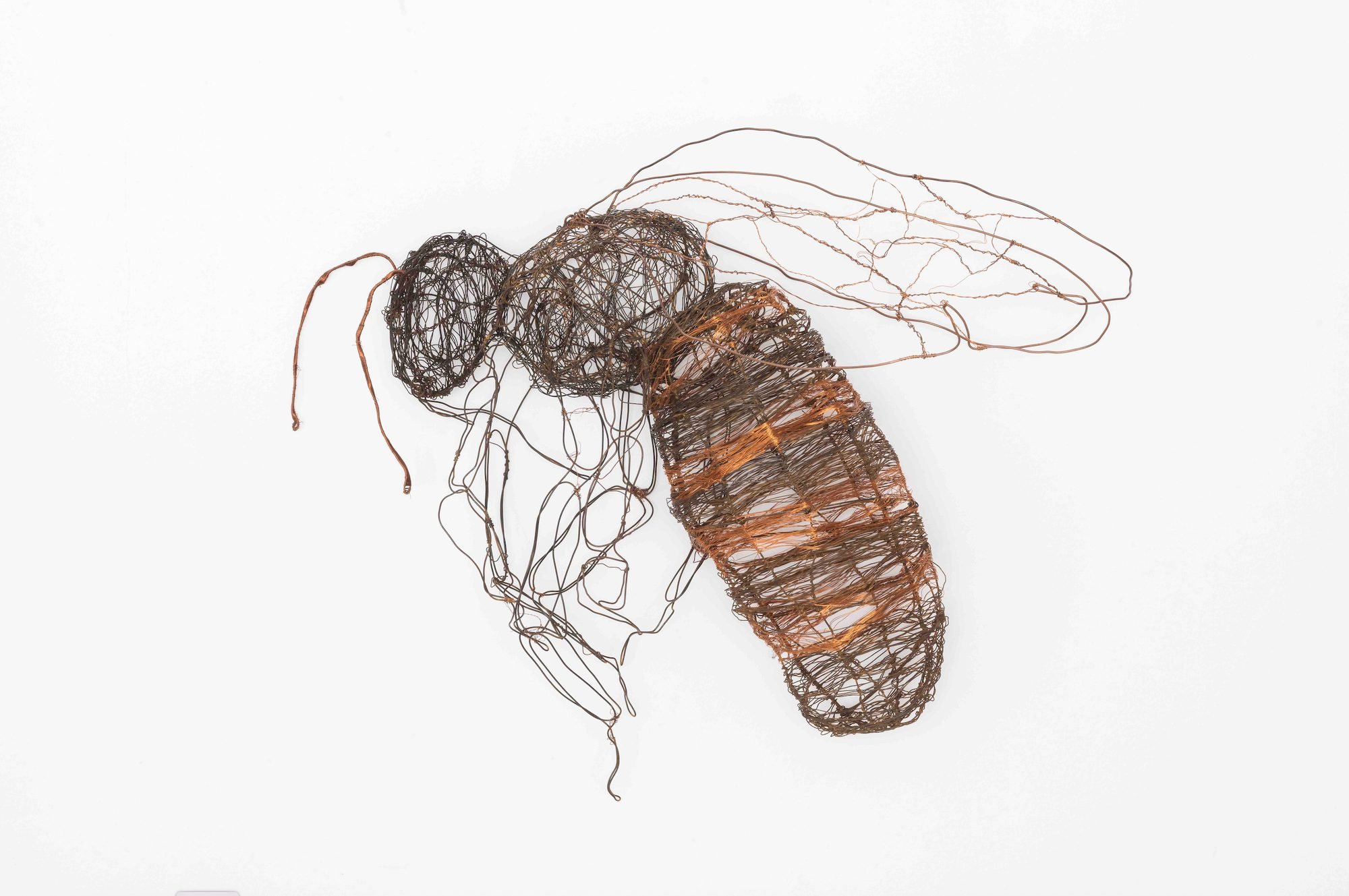
Image shared by Charmaine Lurch.
Thank you for inviting me to be part of this conversation. Noticing the bees and seeing the bees has brought community to me in beautiful and surprising ways. I create organic hand-bent structures representing specific bees, mostly wild bees. I'm drawn to building artworks that might broaden ways of knowing and understanding our relationships to these beings. I make charcoal drawings, paint, build public sculptures and bend wire to re-imagine new worldviews. Wirework brings a closer expression of the bees. Wire as both material and language can intertwine theory, black creative practices and environmental possibilities.
I come to this work through talking to gardeners and farmers and pickers and planters and my next-door neighbour and people I'm sure, like you, who I know are very interested in understanding the bees, observing the bees, and noticing them. The wire bee sculptures are visual assemblages that are a kind of architecture that hold both interior and exterior sensibilities, prompting us to look at what it means to live inside and outside of things. This practice is action, and most of all its collaboration: enabling contemplation on abstract theories connecting culture, art and science.
The bees have a specific connection to theoretical conversations from both Caribbean and Canadian scholars whose work informs my practice. Specifically, I look to the work of Sylvia Wynter and Edouard Glissant and, as Kate mentioned, Katherine McKittrick. Their discussions help me to think about Black methodology, geography, ecology, experiences of people living in different spaces, and references to movement and migration. Movement is embedded in the sculptures through a constructed porosity in the way that wire is woven, allowing the eye to see-through to the environment. This might help in imagining boundaries and spaces in new ways.
I'll finish with some words regarding my bees from Katherine:
Wire allows us to link art worlds to metals, and thus computer hard drives, vascular stents, data cable, piano strings, guitar strings, and fences in wire. We're given finance, empire, environmental decay, exploitation, and enclosure. In wire, we're given sound. Lurch’s bees are an expression of expansive and unfinished relationalities. These are lessons through which we become agentive learners and readers as prompts that adjust our relationship with physiography, while leaving room for wonder.
I hope these ideas might become a point of reference for our discussion.
Further discussions by K. McKittrick on Charmaine’s bees can be found in: Holberg Symposium, “Wires, Kerosene, Data,” 2019 • McKittrick’s Artforum Discussion, 2020 • Dear Science and other Stories, 2021, 20 Dreams, 2024.
Oreet Ashery, Artist
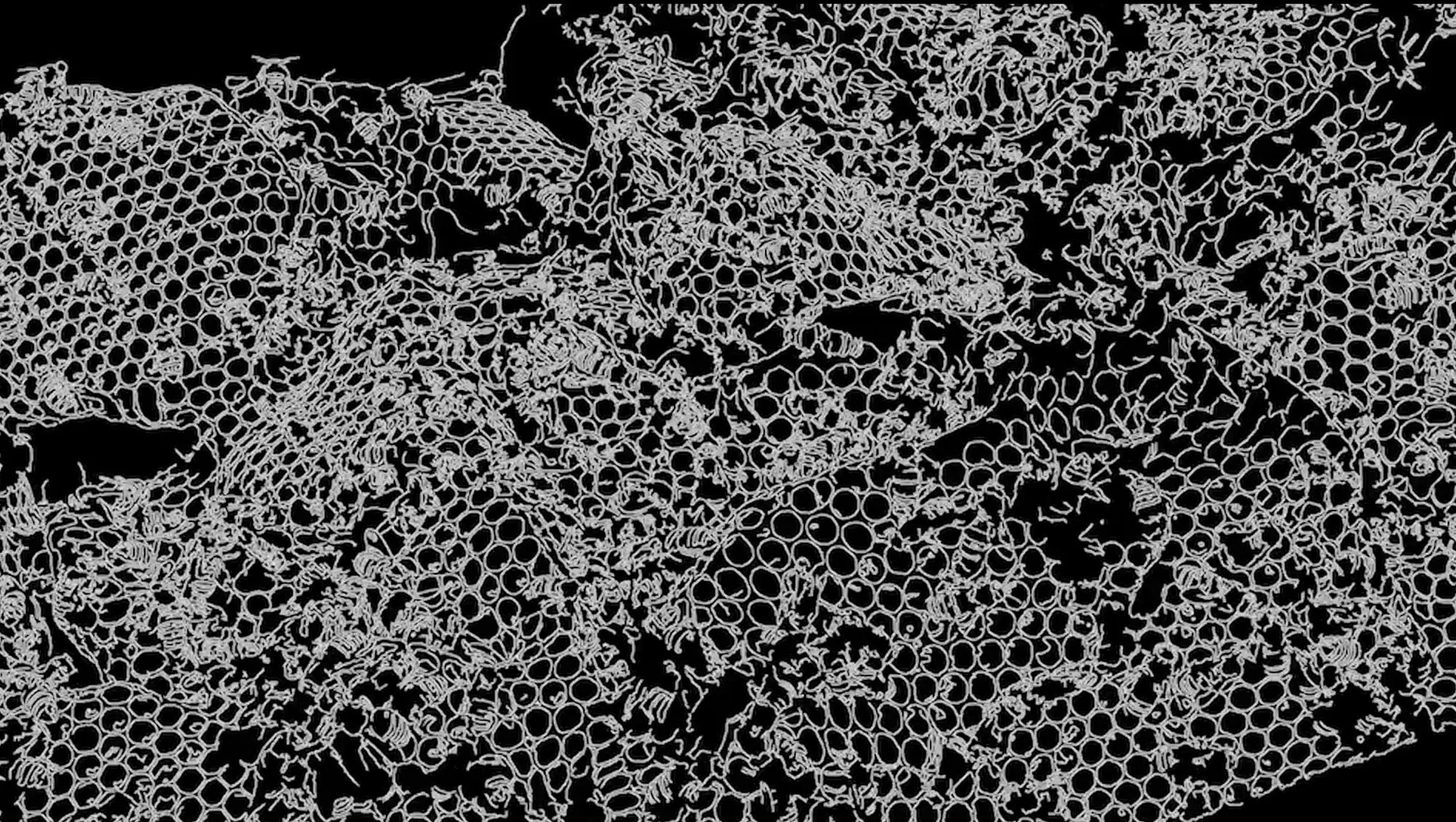
Image shared by Oreet Ashery.
Hello. It's been great to hear from everyone in the gathering and look at what people are doing in relation to creativity, environmental and social justice and bees. There's a structure that seems to hold all this together, but we just don't know what's coming next. We don't know what's going to come out of this occasion… We are creating contexts for doing things together (togetherness), even if, or perhaps because, we don’t yet know what it is. It is rewarding not to over-plan, but to let things evolve and head where they want to be heading. Where connections may lead is always more surprising than anything we might imagine in advance. I feel reassured knowing that our ancestors across the globe have always travelled short and long distances to come together and share stories and knowledge. At a time when so much of how we relate to others is indirect, meeting in one space, be it virtual or physical, is a form of learning and place making.
Beeing Together is a free-form collaboration that I initiated in 2025. Since then, I have been immersed in it in different capacities with Ali (Alzein), Kate (Keohane) and Beatrice (Lily Lorigan), who are all here today, alongside others who are not present. This gathering is a collaboration between Beeing Together and Art Hx, something I didn’t envisage at the start, yet it holds new potentials. The focus of Beeing Together so far has been an art residency at Bees & Refugees, where Ali and I have come together with others to build a large clay Chula and clay benches. The process of building the stove from cob over several occasions has put us in touch with the clay, which is soil; with each other; and with the bees, who were attracted to the coolness of the clay and the minerals it contains. The chickens loved the sand bath (our cob was made from rescued clay, water, sand, and hay) and were entertaining for some. The Chula was built to bring displaced people together. For many people who are part of Bees & Refugees, cooking and eating outside are part of belonging.
The people who built the stove are not necessarily those who will use it. But maybe the stove is just a new hive for the bees. Recently we all took part in an intimate event with music improvisations, liberation songs, and spoken-word poetry by Farah Chamma, which included a long delicious collective dhal cooking session. There was a kind of energy that was emitted from the Chula that carries the hands, sweat, investment and love of everyone who took part, in person or in spirit. It acts as a situated performance, a social sculpture, a generative cooking medium, a film-set, and a site for social relations.
On the night, we got feedback from a clay engineer that we have too much smoke coming from the wrong cavities and that the beauty of cobbing is that it is malleable and we can change it. Another feedback was that it would be good to have a placard alongside the Chula that tells people something about it, especially those who are using it but were not part of the process. This kind of feedback is invaluable in showing where the blind spots of the project are. We have been thinking about what the placard could say.
In the WhatsApp chat of the collaborators, we responded to the feedback, reflecting on how the Chula is responsive and requires adjustments and maintaining over time to align with changing conditions. Roo, the artist who led the Chula building session, wrote:
[14/07/2026, 17:40:47] Roo Dhissou: exactly, the Chula is embodied and grows and repairs with us. It can last forever with good care, and we can keep adding to it however we want, as we grow.
Maybe this will be the placard.
We created a 20-minute documentary that charts the foundation laying and cobbing process. It will be accessible online for people who wish to learn how to make their own cob Chula and benches. The benches keep cool in the heat we’ve been having here.
Hen and I have been filming Ali and his reciprocal relationship with the bees. It made me think about the edges between people, bees, the horizon, the ground, and fauna, and how porous these edges are. Hen and I have been experimenting with an edge detection algorithm to abstract and destabilise the firm separation between all the elements and create a fluid flow of video sequencing that is indicative of the interdependence of everything. Edges are in some ways a colonial construct, and in another way, something meaningful to be respected equally by all involved. When you look at the footage of Ali and the bees, you can experience deeply the respectful negotiation of edges and boundaries between them, and those edges are negotiated. Like when Ali suddenly notices the vibration from a guard bee, and wonders if he might be speaking too loudly. Witnessing those vibrational negotiations when thinking about care, is a learning curve. The edge detection algorithm with its white outlines, when it has been appropriated or misused by us in editing, has a magical quality. We didn’t use it for its purpose but instead adapted the technology to obscure the separation between the various elements in the footage. We wanted to emphasise the oscillation between a lack of distinctiveness and a more detailed portrayal of the outlines that make us perceive a person, or a leaf or a bee.
The word absence was raised by Emilia (Beatriz), and I felt it in my body. And maybe also grief. It made me think of absence in relation to the edge detection footage that I described and shared. There are many dark areas without outlines, but there is no absence there— so much is happening between and across the outlines of Ali, the bees, the sky and the trees. It is always shifting. There is no actual absence in the areas without clear definitions, only aliveness.
Rebecca Wood, Comb Cutters
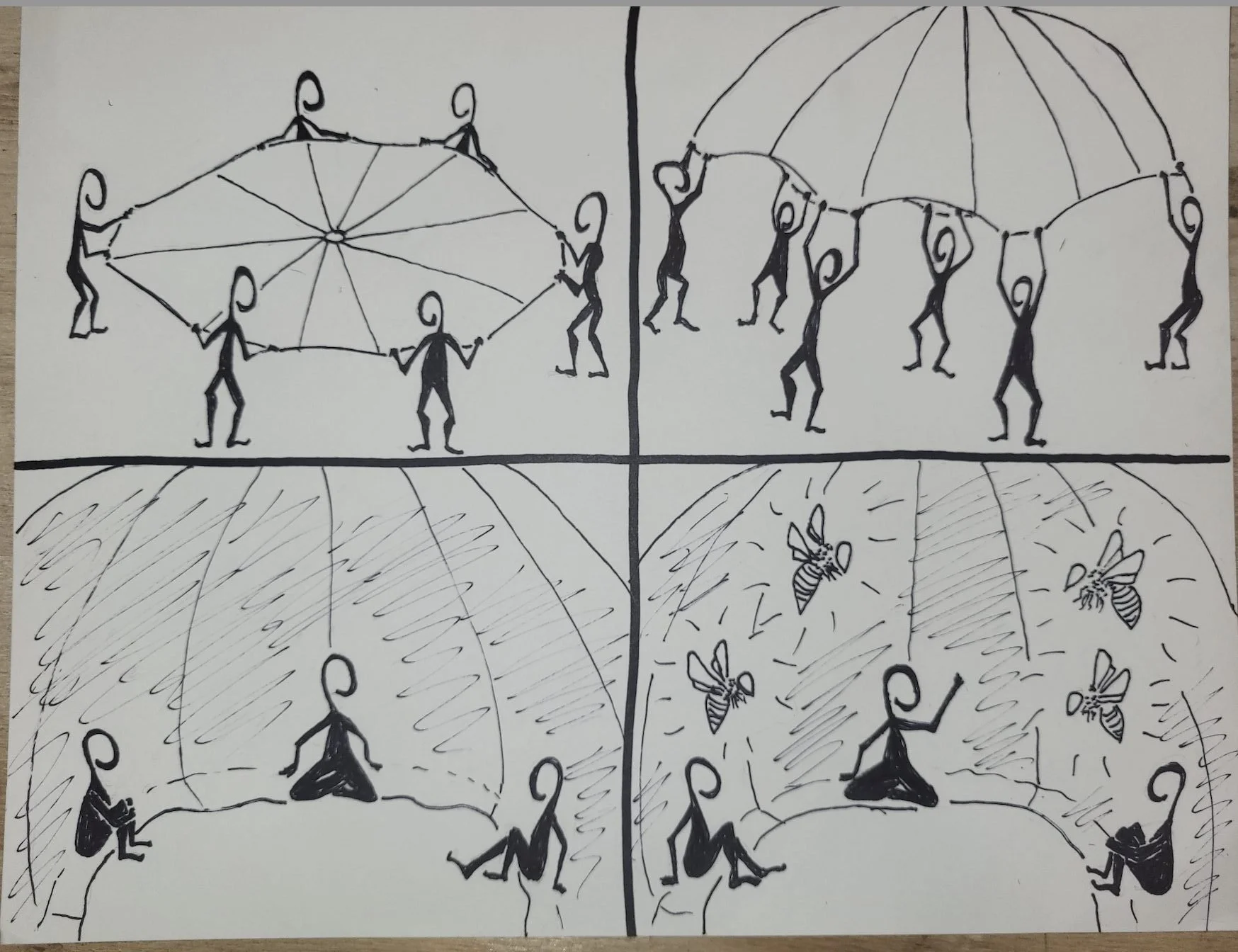
Image shared by Rebecca Wood, Comb Cutters.
Thank you so much. My name is Rebecca. I'm a beekeeper in Miami and I'm part of a cooperative of beekeepers called Comb Cutters. This conversation is perfect for us, because we work with bees, of course, but what we really love to do is use bees as a medium to build the world we want to see. We teach the lessons we learn from the bees and use these as a tool. I had a lot of things I was thinking about talking about today, but the one that I landed on is one that we've really been excited about lately, which is the concept of social immunity or collective immunity, which, if folks have researched propolis, you may have come across this concept before. I'll give a real quick synopsis of what propolis is from my point of view, and then talk about social immunity, and talk about my drawing.
So, propolis, the way I think about it, is this incredible example of reciprocity between bees, the ecology around them, and us. It's a medicine or a form of protection that bees borrow from the trees. It's 50% tree resin, which is something that trees produce as an antifungal, antimicrobial. The bees borrow it, they change it a little bit, but in its base it really remains the same, and they use it to seal everything in their hive to keep out pests, parasites, weather, and bad bacteria, all kinds of things. Then we as humans can also borrow it and use it as medicine, so it's a form of protection that travels between all of us. But if you're reading about these things, you'll read that when scientists mapped the genome of the Western honeybee they found that honeybees, or Western honeybees specifically, have far fewer genes that are dedicated to their individual immune systems than most other insects, which is an interesting thing, because Western honeybees have these complex forms of communication and the ability to do so many things. But the concept, the theory behind that is that they don't need as strong of an individual immune system, because they have propolis as this collective immune system: this shield that's protecting the entire hive. In theory, with this shield, they don't need to dedicate as much of their individual resources to immunity, they already have it taken care of, and that can allow their bodies to expend energy on all kinds of other things.
We've been thinking about this concept a lot, and posing it to our communities: what are the ways that we can build social immunity in our communities? What are the ways that we can collectively build or share responsibility, so that we can ease some of the weight on each other individually?
And then this morning, I didn't have an image to share, but I actually had two dreams early this morning, and they were both about this gathering. One of them was that we were all together in person, and we were playing with parachutes. I don't know if this is something that happens with children all over the world or if it's a more like U.S.-centered experience, but when I was a child we’d play with parachutes, and you hold them all together, and then you throw them up in the air and catch the air, bring it down really fast, and you sit inside of it. And in my dream, we were all doing that together, and it feels like a pretty clear example of building this collective shield. But also I remember how it felt as a kid to sit inside that blown up parachute, and it almost felt like this totally different world. Kind of like being in a cave or something. All of a sudden you and the other people around you are just in this whole new world together, and it feels somehow very magical. So I just thought I would draw a little comic to represent that, and put some bees in at the end, because why not.
Sarah Khan, Artist
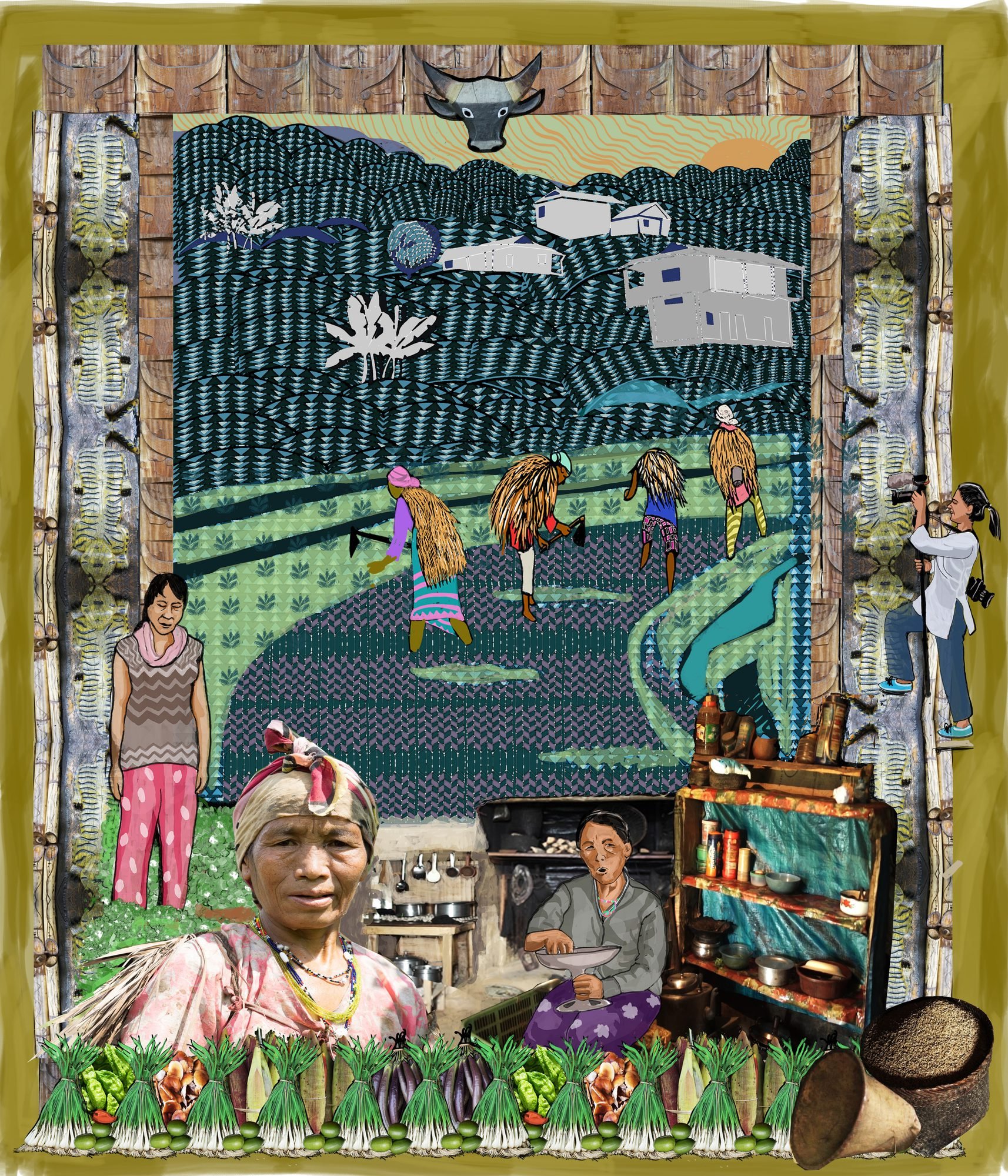
Image shared by Sarah Khan.
Thank you. It's a privilege and pleasure to be with you. With a lot of these talks, especially when they're short, I kind of wait to see what the powers that be tell me to say. It's nice getting older, and just seeing what comes. So, I don't know how long this will last, but we'll see.
The foundation of my work began when I equated human rights with land rights. I am a daughter of partition. I call myself a Kashmiri Punjabi. I'm just beginning not to use the borders and the definitions of the nation state so I can be located in a different way that's more in attunement with my ancestors and where I come from and what I've chosen: chosen to then study and then fill my life with, in addition to the ancestral stuff.
I remember being a teenager and being educated in the United States, and my father saying, “Sarah, I lived through partition, there have been many genocides, and I want you to be cognizant of the multiple histories that aren't told and are told, and what gets privileged and what doesn't get privileged.” So Indigenous knowledge, who gets to practice it, and how they get to practice it. I realized as a teenager this was very connected to land rights. Fast forward 30, 40, 50 years, and I have a grant to do some work in India.
It's difficult for me to go to India unless I have a grant, because the nation state of Pakistan is my birthplace, and it's just complicated. And another way to say, not all U.S. citizens are treated the same. I went there to do research on women farmers, and I worked with Indians of African descent, the women farmers in Karnataka. I worked with Rajasthani Mirasi caste singers who were singers but also labored on farmlands. I worked with Dalit farmers, or lower-caste farmers. I worked with Indigenous farmers, and over the years of going to India on a regular basis, the Northeast was off limits, but by the time of my last visit, I was able to go.
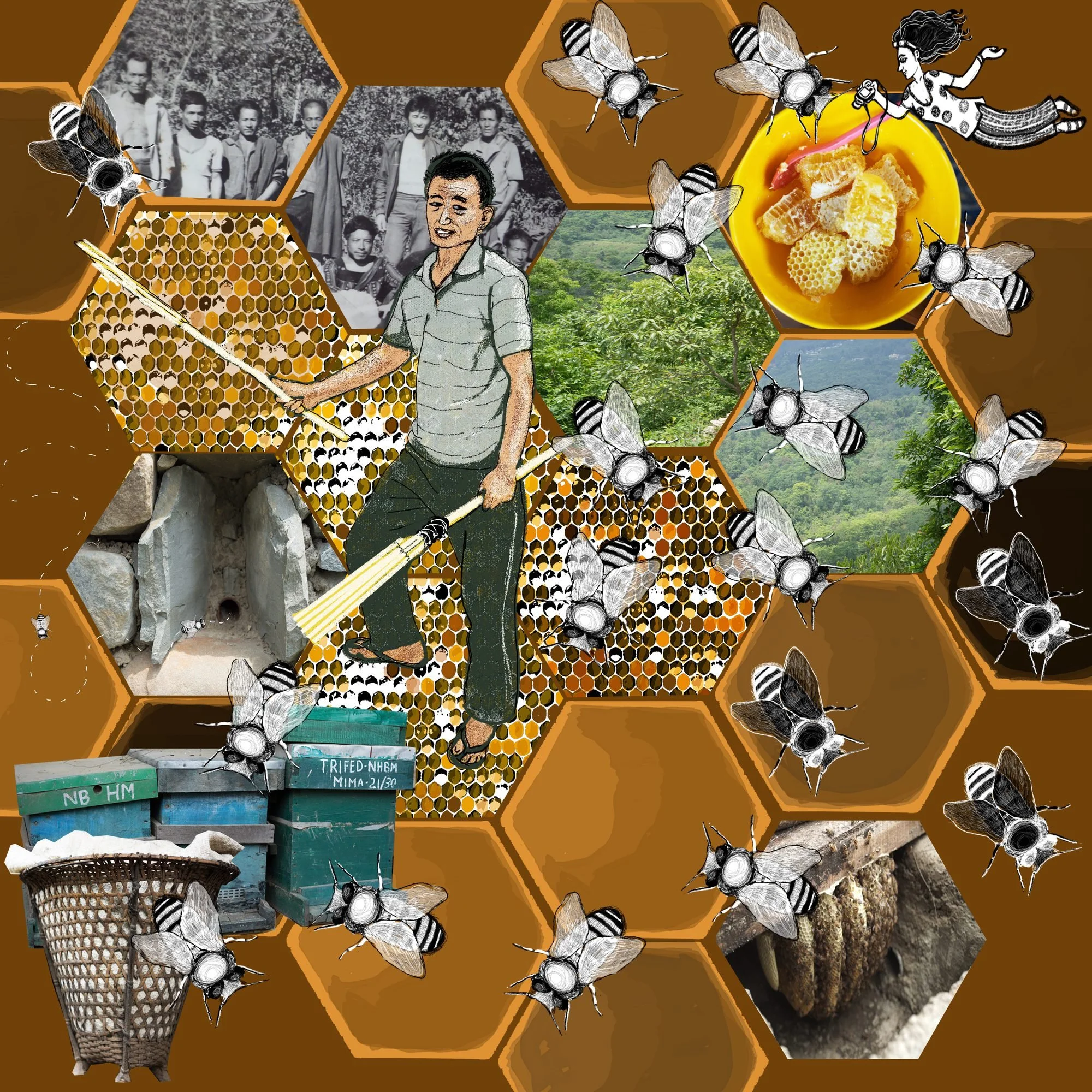
Suse Kamu, Mima Village, Nagaland. Image shared by Sarah Khan.
This image shows Suse Kamu. He's a beekeeper in Nagaland in Mima Village, and he'd been raising bees since 1981. I have eight vignette photos like this of different women farmers, for lack of a better word, in situ, not cleaned up, for example, if they were wearing a Mickey Mouse T-shirt, we kept the Mickey Mouse T-shirt on, because that is the global world that we live in. And if you're able to see closely, right above Kamu’s head and to the left, there's a young Suse Kamu, learning beekeeping with the native indigenous bee Apis cerana. Kamu spoke in a way that was careful, I think, but he just said “our fighters, when they were in the jungles for many days and didn't have food, learned about beekeeping tradition, the bees, and would eat the honey”. These practices were his teacher.
Many of you have already talked about how the bees teach you and or communities directly and indirectly. And Suse Kamu was no different. Throughout the interview with him, he spoke about how much they had taught him how to live and how to take care and how to be present and innovate. This is one vignette of many. It's all connected, as we know. You guys know this already, but human rights, land rights, and the capacity to practice holding our cultures together are so profoundly connected to what comes from the land. I think that's what I want to share in this moment. And I thank you for being present and for creating a safe space.
Rebecca Ann Robertson, Mayan Melipona Bee Sanctuary
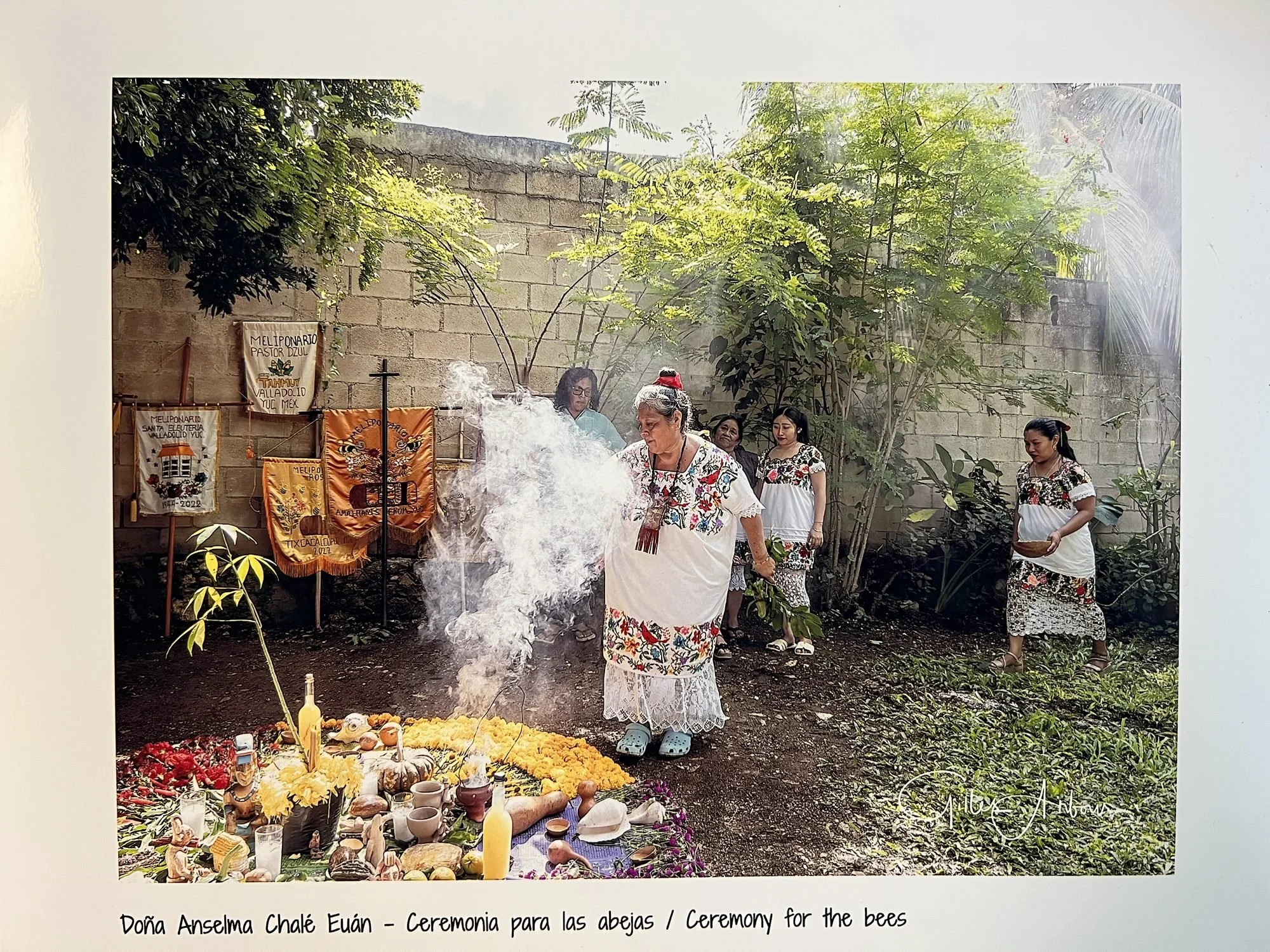
Doña Anselma Chalé Euán – Ceremony for the bees.
Hello everyone. I am the director of the Mayan Melipona Bee Project, which is located in Mexico, in the Yucatan Peninsula, and we work exclusively with Maya people, primarily with Maya women. The Mayan people have been in sacred relationship for over 3000 years with their little native stingless tropical bee, and this is a honeybee. The honeybee makes the most medicinal honey on the planet, and the Maya people use that honey in their healing remedies.
This image is an image of a ceremony that we had in our bee sanctuary about two years ago, and the reason I chose this photograph is because it really encompasses the relationship of the Maya people with the bee. In the Maya language, the word for bee is Xunán Kab, which means royal bee. The word Kab (bee) is the same word in the Mayan language for world, so bee and world are equivalent. There is always a ceremony to ask permission of the land of Gaia and the cosmos. The two are not separated, Gaia and the cosmos. There's a ceremony to ask permission of the land before they choose the location to build a bee yard, before they bring the bees there, they'll ask the bees, is it okay with you? Would you like to live here? And if you do, I will attend to you. I will bless your wings. I will thank you for your work.
This ceremony takes place at least once a year, where you can see they've laid a beautiful altar on the ground with flowers and the fruits of the land and the sacred drink, which is Balché, and that Balché is made from the Melipona honey. All the elements of the land are laid there to entice, to bless, to thank, to beautify the relationship of the bees and their bee tender.
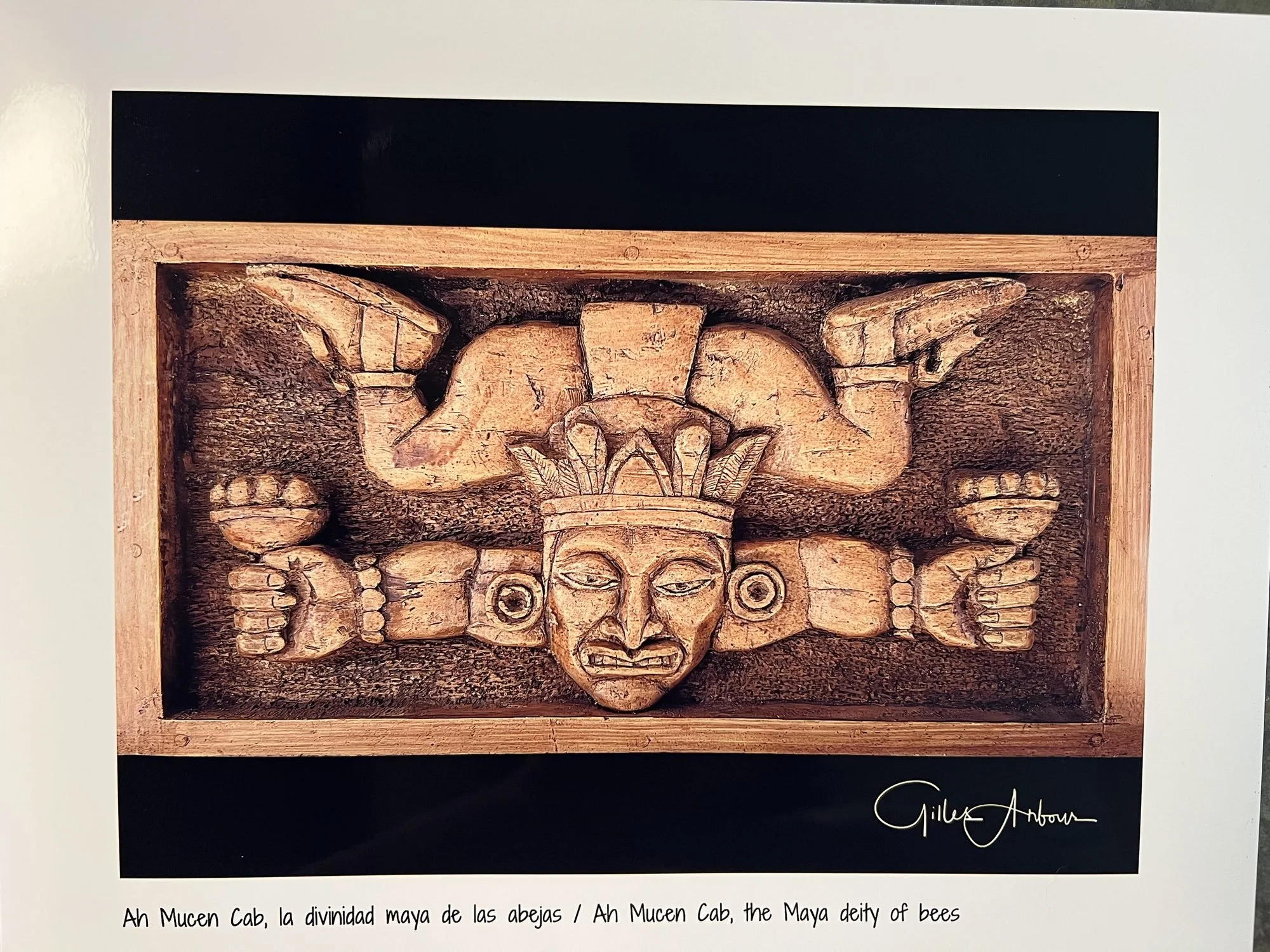
Ah Mucen Cab, the Maya deity of bees.
This image is Ah Mucen Cab, the bee god, and this is an image that's carved over the temples. It's a guardian, basically a guardian bee who guards the temple, and the guardian bee will guard the beehive, and the guardian bee will guard us as well. There is a deep, long relationship of the bees, Xunán Kab, and the beekeepers. The Maya people believe that the bees carry their spirit across the veil. They bring the incoming souls in, and they help the outgoing souls cross the veil in death. If you see an image of the bee nest, it's shaped like a spiral pyramid, and the Maya people will tell you that the bees taught them how to build the pyramid, so again the bees are a sacred temple, and the intermediary between the cosmos, this the spirit world, and us, the human world. This is an image of the bees themselves: they're about half the size of Apis mellifera, a European honeybee. You might notice they have blue eyes, and they don't build honeycombs, they build honey pots, and these honey pots are made of wax and resins from the tropical forest. A tree will create a resin to heal its own wound, so the bees are collecting those resins and making little egg-shaped honey pots and storing their honey in those honey pots. Not only is it the alchemy of the nectar of these tropical rain forest plants and the alchemy of the bee herself, but it's stored in a resin pot that's then also infusing the honey with the medicinal qualities of the resin.
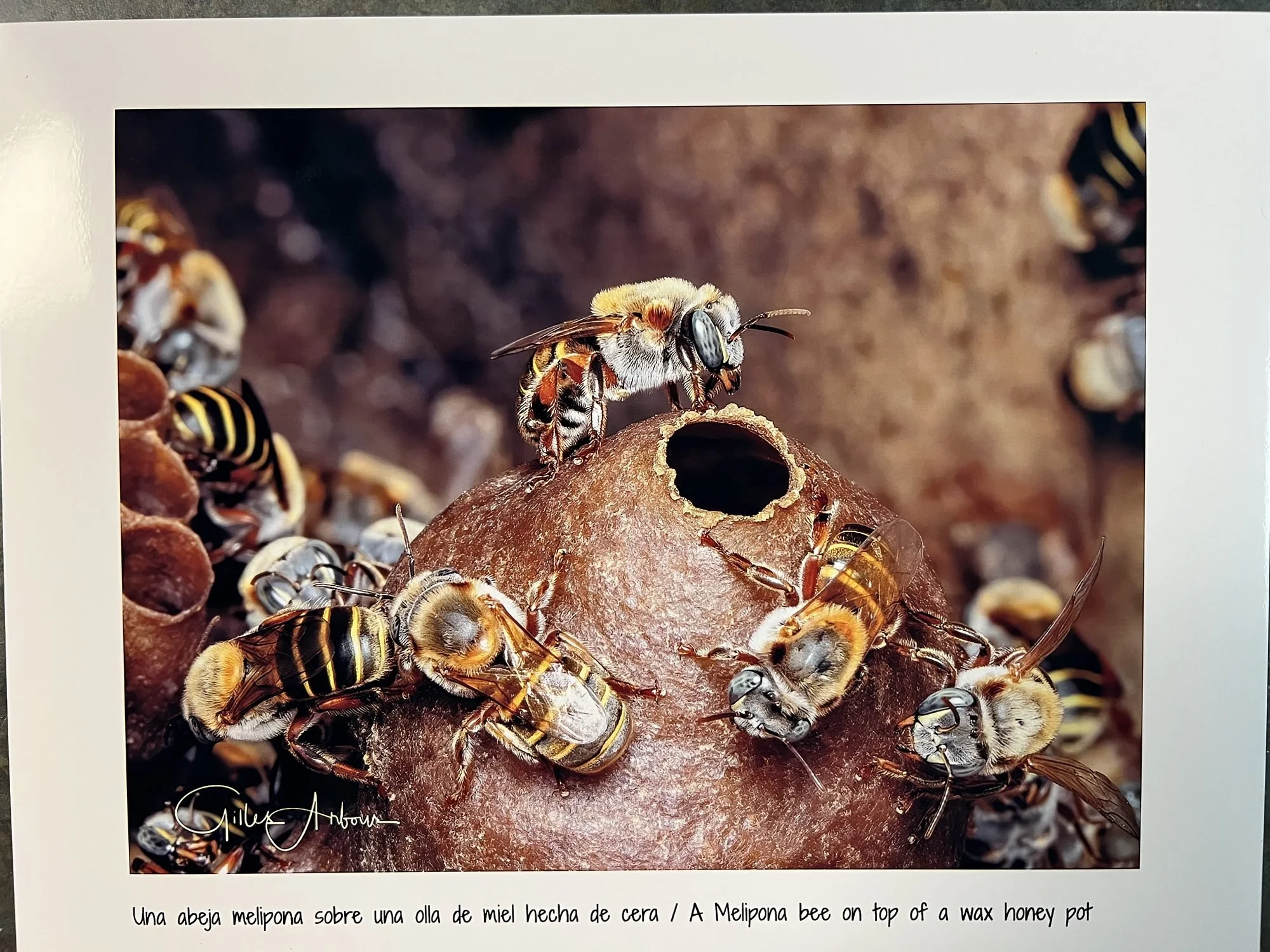
A Melipona bee on top of a wax honey pot.
Ang Roell, They Keep Bees
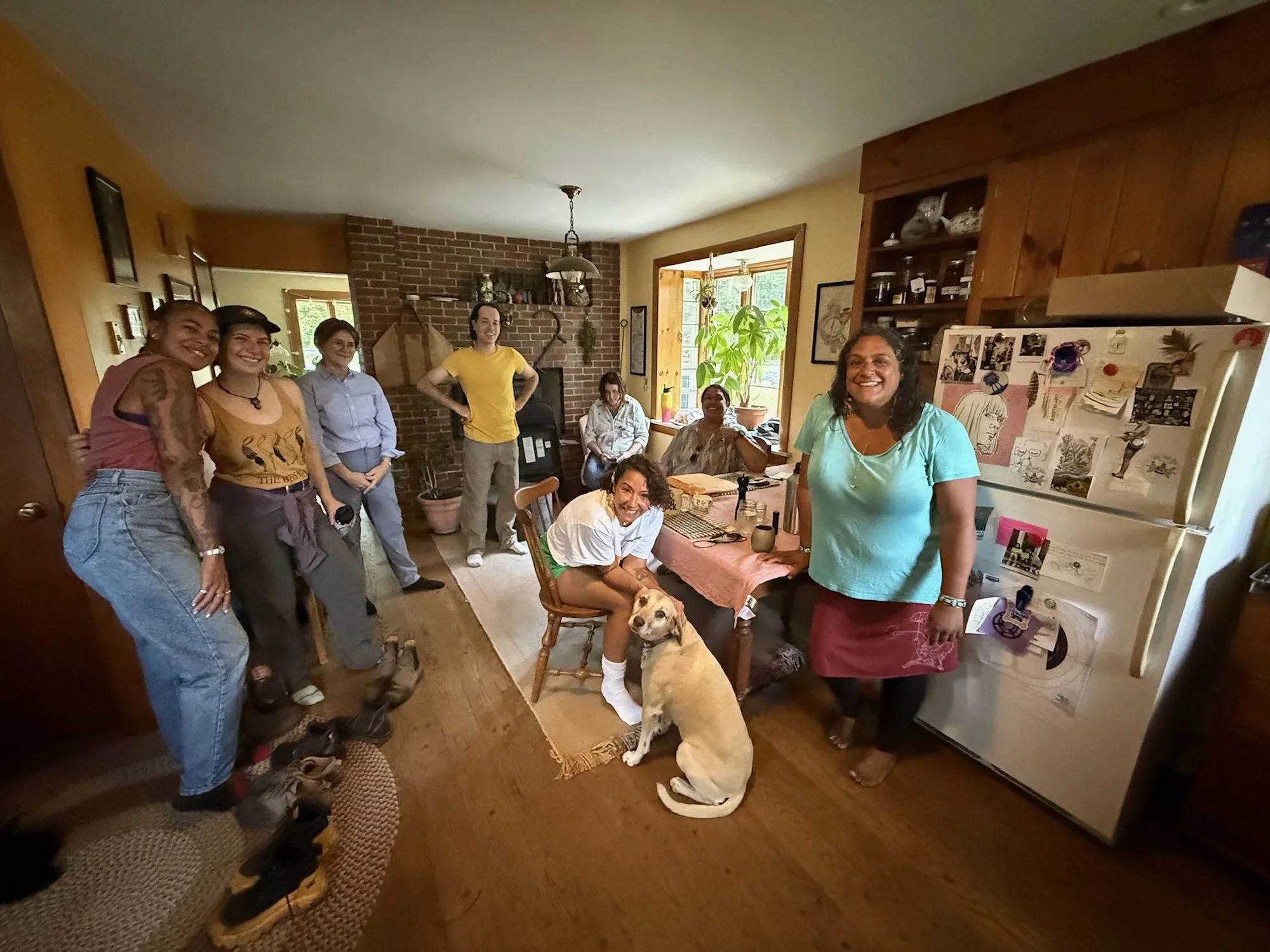
Image shared by Ang Roell, They Keep Bees.
Hi everyone, my name is Ang. I am a co-founder of They Keep Bees, which is a beekeeping business that produces honey, beeswax, and queen honeybees. TKB also facilitates skill shares and helps build social resilience within our community. I've been a beekeeper for fourteen years, and I've been doing it professionally for nine. In the world of beekeeping, I'm sort of like a specialist technician, so I do queen production through things like grafting and making cell raisers, and raising queen bees in the field. I also do instrumental insemination and drone semen collection using a microscope. Both are tools used for the express purpose of preserving and conserving diverse honeybee genetics in the United States. I am currently part of a national team collecting and conserving honey bee germplasm (sperm) in a cryopreservation germplasm seed bank. The function of that work is to increase the number of samples we have preserved for species conservation. Our US based team is lucky to collaborate with international partners in Poland and Spain, who are on the cutting edge of honeybee genetic conservation.
I'm coming into this room with a technical lens, but my work is also strongly rooted in community. One of the They Keep Bees programs is called Queen School, where we teach people all of the different ways that you can raise queen bees, all the way from simple walk-away split methods to instrumental insemination, and we were teaching that course for several years when Stacey, who's in the middle of this photo with my dog, Chiva, approached us and said, “What if we build a network? A collaborative network across the Northeast.” And so we started talking about what that would look like, what we would be providing other beekeepers, what kind of collaborations we wanted to have. We started building that network in 2024 with a program where we offer technical support, mentorship, and honeybees to people who either were starting out in beekeeping or were really looking to expand their apiaries. We now have collaborators for this program in New York, Massachusetts, and Rhode Island, in the Northeastern U.S.
You might be looking at this photo and thinking -- this is not a photo of bees at all. This is a photo of some of the leadership of the network I just described. Stacey, who's in the middle, and Brenda, who is to my left, are a part of Island Bee Project, which is a New York City-based collaborative of beekeepers, and then Jen, who's in the teal shirt, runs a farm in the Berkshires called Woven Roots, which is a food and land justice project, and she has also been a beekeeper for many years. With them and my partner, Bi, who's in the yellow shirt in the middle, we've been leading the network since 2024 and then the other people in this photo are some of my mentors, Melanie Kirby. Who's been a mentor of mine since 2016, Julia Mahood, and then Megan Mahoney.
In this network, They Keep Bees focuses on collaboration up and down experience levels, and the people that are leading this network are not just beekeepers, but also skilled facilitators and community organizers, and so we are not just creating a technical skill network, we're really creating a place, a safe place for people to be and learn and grow together. It's really grown to be a question of “how does this network continue to build social resilience?” Not just for beekeepers, but also for our communities. That's a question we haven't answered yet, but we get to explore next.
At the heart of this network is relationships: everything that has happened over a decade of building strong collaborations with mentors, with mentees, with other farmers in our region, and with people across the northeastern U.S. region. And so when I was thinking about what picture to bring here, it felt really critical to try to represent the web of relationships of the people who are leading and teaching and collaborating as it takes shape. They're all in my kitchen, which is my favorite place to be. I chose this photo because relationality is such a foundation of the work that we do. It felt critical to uplift the entire leadership of this network.
Ali Alzein, Bees and Refugees
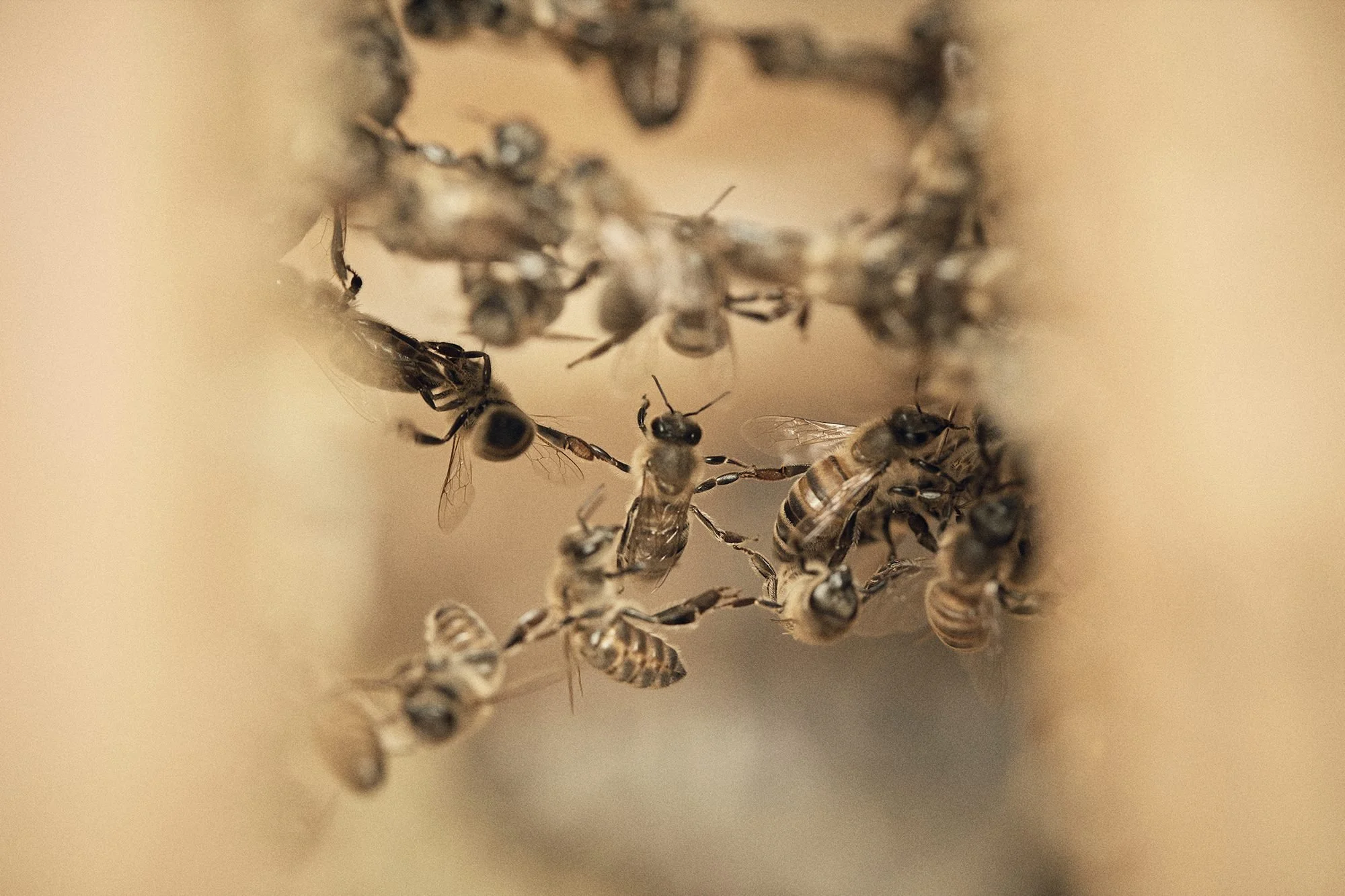
Image shared by Ali Alzein, Bees and Refugees.
First of all, thank you for inviting me. My name is Ali. I'm the founder of Bees and Refugees. We're a community project using beekeeping and nature as a form of therapy. I wanted to share this photo I took when I started Bees and Refugees because it captures something quite fundamental about how bees organize. What you're seeing here isn't just movement, it's structure. The hive is literally built together by bees holding on to one another, there is no central point of control here. What holds everything together is relationship. Each bee is responding to others, adjusting, supporting, and that's what creates stability. And in our work we often see people who have been separated from those kinds of structures: from community and from a sense of being held within something. What we try to do isn't rebuild that in a top down way, but to create the conditions where those connections can form again. Working with these creatures and land becomes a form of remedy, not because it fixes anything directly, but because it allows people to re-enter the system of care, rhythm, and interdependence.
One thing that I keep coming back to is how fragile this is. If you remove too many bees, the whole structure weakens, and I think there is something in that for how we think about communities under pressure or displacement or systems that extract without giving back. I'm still thinking about how and what it means to build something that heals without extracting, and what we can learn from systems like this, like honeybees’ systems that are entirely based on holding each other up. This is my contribution, and I'm excited to be in this discussion and to learn from all of you. Thank you.
Hana' / Soul Fire Farm
My name is Hana'. She, her pronouns. I'm a farmer and beekeeper in Palestinian and Jordanian diaspora. Professionally, I co-manage the farm at Soul Fire Farm, and I also co-lead our community outreach and youth programs. I have been farming for 10 years and beekeeping for 7 years. In my free time, I organize farmers and beekeepers - and just human beings - to help bring more justice into this world, and most of that work revolves around Palestine right now, and with Comb Cutters. So, hi Rebecca! We do a lot of work on “Storytime from Palestine”, inspired by hearing from our friends in Palestine. Storytime from Palestine is a place where we bring farmers and beekeeping together on an international webinar to talk about what's going on right now. This is intentional. Just as Israel and the US went on a massive killing spree of press and journalists to silence stories coming out from the region, we are countering that by having a platform to continue to shed stories and light. There's so many stories that are constantly pouring out, and really just having a container to be heard and visibilized and have truth when there's so much being hidden. So that's actually where this photo comes into play, and what I wanted to share about today. I think we've all heard that a photo is like 1000 words, but in pictures that I take in Palestine, it's like the photos are 1000 stories. I wanted to tell one of many stories: how beekeeping practices differ not just due to our individual and collective practices, but how the “normal” and simple and spiritual aspect of beekeeping can be changed due to abnormal situations that are around us. So really just trying to figure out, what does it look like to beekeep under an intense illegal military siege? That's not something I've ever had to live through before, and so in this case, and in Palestine, it's not just climate change that is the abnormal factor around us, or you know, the regular beekeeping mishaps. There's a violent, ruthless, terrorizing campaign of not just the Palestinian people, but of the homeland as well, of the actual land itself, by illegal Israeli and US colonization.
So, my question is, what does it look like to beekeep under looming death and violence? And I want to also center that this is not unique to Palestine by any means. We can look through history to so many people and spirits and blood on homeland who have also survived through these types of atrocities, and also thrived because they are still here today, still practicing their ancestral practices, and also remembering that the colonizer always loses.
So, with this photo, I want to speak about the Arabic word aadi (عادي). You'll always hear aadi, aadi, it means “normal”, and so many times when we were beekeeping in Palestine, under very abnormal conditions, they would just say aadi, aadi. This photo becomes a story of what is aadi and not aadi here. This is my friend Rima on the left and our friend Mohammed on the right. I met Rima about two years ago when I went to Palestine for the second time on a trip where we were teaching beekeeping workshops in the country, Rima lives in a small village outside of where I was living at the time in Palestine, and we oftentimes are not able to say the name of the villages, right, because there's a safety concern, and also that is erasure in itself, and that is not normal, mish aadi, at all. She mentions to me when I met her at the beekeeping class that she's part of this small collective of beekeepers, and of course invites me over to her home for tea, as always, and she wants to check her bees together. And so this was actually my second time I was able to visit her, last time when I was just there over the winter. Her farm is not very far away from where I was staying, about 35 to 45 minutes, but there were so many, I call them ‘stop and harass’ points, because you're not really “checking’ for anything. It’s similar to what stop and frisk is in the U.S. A lot of these harassment points litter the road on our way to go help Rima beekeep, so it took us 3 hours to arrive this day. Imagine going over to visit your friend for tea a half hour away but you’re prepared to make it a three hour drive one way, literally risking your life… But we get there, and we quickly started to suit up, and she's pulling her gloves onto her hands, and they're extremely well worn, like she has used these things to the end of their days. There's almost a hole in every single fingertip on both hands in her gloves, and she gets stung there very often, she told me, and it makes it really hard for her to care for herself after she gets stung, hard for her to take care of her family and her kids, and cook and do homework and play, and also beekeep. She then looks for an extra pair of gloves for me to wear, and she didn't have any, and I asked her: so, if we wanted to source new ones, how would we do that? Very simply, how do we get a pair of beekeeping gloves? And she said: oh, it would be so nice if we could get a pair, but everything is under siege, and it's extremely expensive right now, so we actually can't afford it. But, Alhamdulillah, aadi aadi, it's normal, it's normal, don't worry about it.”
So she puts these gloves on that don't cover her hands, and we start to walk through her bee yard, and the sky quite literally starts to shake, and I look up and there are several warplanes flying in circles above us. My body freezes in full step, because although I've been here for the second year, and the warplanes circled around us for several months at a time, they were still not normal to me. They're not normal to anybody under any circumstance, but she joyfully just continues walking towards her bees. She doesn't miss a step, and I turn to her, and I say, “Rima, okay, I know we've seen a lot of these planes, but this one is extremely low, like it's unexpectedly low to the ground. Do you know why?” And she was like, "Oh, aadi aadi, they're just creating noise, psychological warfare, they put sound bombs in the sky and they try to force us to leave. But don't worry, we're never going to leave, it's normal, it's aadi,” and I kind of continued in my pause, and I asked her, “but Rima, how does that impact you?” and she said, “me?” she kind of laughed a little bit, and she goes, “it's a good question, but really the bees are going to tell you.” The bees will tell you how it impacts us, we are all one. As we walk over to the hives with holes in our gloves and Israeli/US warplanes circling above us, I was curious what the bees were going to say.
So, after a couple minutes of the warplanes agitating the sky, they leave behind toxic chemicals from their exhaust, which we know will also impact the bees. We go to open the hives, and the hives are almost rumbling with the vibration of the bees, of how agitated they are. She continues to tell me that because of this siege it can be really hard for her to even get feed for her bees. So they've actually planted a lot of cactuses, in hopes that it will flower and provide some food - so in the left side of the image you can see one of the cactuses that she's planted - and she also reminded me that the Arabic word for patience and cactus have the same roots: so there's sabr and sabaar, so if that tells you anything about the way in which we're moving throughout our beekeeping practices together, the cactus can be our symbol.
Rima is not the only story, right? There's so many side stories that come from here. But after months of spending time with different beekeepers and farmers, we learn of things that are not normal, are mish aadi, but are aadi to them. I have met so many beekeepers who have told me that their hives have been stolen, or their whole apiaries have been stolen. They've talked about how their hives have been burned down, their nearby water sources that they put out to bees, the homicidal thieves (settlers) have dumped gasoline into any of the containers of water that they found, which poisoned and killed the bees, and then the beekeepers are also met at gunpoint and demanded to move their hive. Met at gunpoint because of a beehive!! This is all for the act of beekeeping, and what it means to be on your land and food sovereignty, connected to our kin…. what liberation through land actually means. I also learned that there are multiple sieges and consequences. The siege on water that not only prevents the beekeepers from drinking their water, but it prevents bees from drinking water, the siege on movement and the building of apartheid walls prevents the relationships of even nomadic beekeepers, who quite literally move their hives with the honey flow. It prevents these relationships, and these ancestral practices. I also learned that the genocide of people goes hand in hand with the ecoside of their homelands, so as we're talking about, with Rebecca and Comb Cutters; it's not just Save the Bees, it's also Save the Beekeepers. So this is all to say, when I came back here, and after the snow had melted, I started beekeeping again. My first time going into the hive, I paused, and I remembered once I was in the hive, how almost not normal it felt to have silent skies above me. There was no psychological warfare harassing me or the bees, and it really just challenged me to question, what have we now accepted as normal, or aadi?
Emilia Beatriz, Artist
Hola, my name is Emilia Beatriz. I'm a Puerto Rican artist based in Glasgow, in Scotland. It's really great to be here with you all. It's an honor. So, first I wanted to talk about the image, which is in my background. This image forms part of current material research that explores a speculative character called the Great Yellow Bumblebee through artworks such as cellular memory of honey, navigational vessels, and Home is a Vibration, which is a title borrowed from Alexis Pauline Gumbs. These combine immersive sensorial installations, spatial sound and vibration, moving image, experimental writing, printmaking, lighting, tactical objects, scent, and materials – in collaboration with bees, earth, and compost worms – such as clay, slip, wax, carbon, honey, pollen, propolis, and plant matter.
Here is a visual description of the image:
A ceramic object glows in UV light. It could be giant or microscopic. The part closest to us is intricate, flower-like, with cupped indentations and holes, undulates as coral or waves licking towards us. It tapers back thinly, like a puckered mouth or flower stem; merging into soft feathery pastel sketches, which drip and protrude ligula, honey spoons, from the hard glowing tongue.
The next thing I wanted to offer and share as part of my practice is an exercise that I invite you to participate in. You can join in or not with cameras or mics on or off as you feel comfortable, and it's going to involve two buzzing techniques over two breaths in and out. The first one is going to be a simple buzzing, and the second relates to a process called buzz pollination, which some of you might know about. Buzz pollination or sonication, is where bees use rapid contractions of their thoracic or flight muscles to dislodge pollen inside tubular flowers like heather. This helps bees control temperature and vibrate at high speed, enabling flight. We humans have thoracic muscles in our chest, and these help us to breathe, support our posture, enable our upper limb movement, and protect our organs. So, following my lead into the first exercise, with hands over the ears, we're going to form a tight cup, and then we're going to breathe in, and as we breathe out, we're going to buzz a sustained low buzz for the length of the breath, as low as you can comfortably go. I find this one easier with my eyes closed. So breathing in… and buzzing out.
For the next one we're going to inhale, and as you exhale, we're going to make many brief buzzes in quick succession, as if we're trying to create a vibration with our chest and breath that will excite the pollen away from the flower. I think this is best to do with the lips kind of open, but your teeth closed, and imagining our chest muscles contracting with each brief buzz. It helps me to put my hands on my chest, so I can feel the movement there. We'll buzz like this rapidly at whatever tone comes out naturally until the end of the breath. So inhaling… and buzz pollinating out.
Gracias for accompanying me with that. Both of those techniques, as I said, relate to this speculative or imaginary character, the great yellow bumblebee, which is based on the critically endangered bee of the same name, a species who existed across the islands known as the UK, but now only survives in remote northern coastlines of Scotland and Ireland's archipelagos. I've come to know this character through interviews with beekeepers and crofters living around Cape Wrath bombing range, and through spending time in the disappearing machairlands, heather-rich peatlands, clover fields on the coastlines of that region.
My bee practice is one of being in study.I first encountered beekeeping in 2011, coming from community art projects and allotments. From 2017 I began recording oral histories with land workers, beekeepers, and herbal medicine practitioners, many of whom had all of those practices both in Puerto Rico and in Scotland, and documenting how their practices related to modes of listening and ways of processing grief or collectively moving through crisis, especially in the wake of Hurricane María. Through this work, I had the honor of studying with Jorge Cora and Ana Elisa Pérez Quintero in land work projects called Finca Conciencia and La Colmena Cimarrona in Vieques, Puerto Rico. The ways in which their bee practices directly address food autonomy, racial justice, land reparations, and decolonial work profoundly impacted the ways I relate to the land to this day, and this shows up in my practice in various ways.
The material explorations described before are about imagining absence, what that taste, smells, and feels like. How to connect with longing for worlds in formation and turning towards and staying attuned to the grief of the present moment as a life-affirming practice that's intrinsically linked to social and environmental justice and anti-colonial movements.
Considering this gathering's prompt to address a current concern regarding bees, I cannot ignore the most urgent concern right now to the ecosystems that bees and humans reciprocally rely on in Cabo Rojo Puerto Rico, which is a land grab called Esencia. Esencia is creating a private city for the mega rich through destroying Puerto Rico's western coastlands and some of our oldest geological, archeological, agricoastal, and environmental resource. This is one part of the ongoing colonial extraction and displacement of our people, ancestral land, culture, and ecosystems. Esencia is backed by Reuben Brothers, who I recently learned are a British company owned by the second richest family in the UK, with self-proclaimed deep ties to the entities currently enacting genocide in Gaza, mass murder and displacement in Palestine and Lebanon. This is indeed the same Reuben Brothers, for which University of Oxford's newest college is named and financed by. So for me the ending of genocide, militarism, and settler colonialism–and supporting the liberation of Indigenous people and land, ecosystems, culture, and stories–are the most urgent concerns affecting bee practices globally.
Jennifer Lauren Martin, Artist
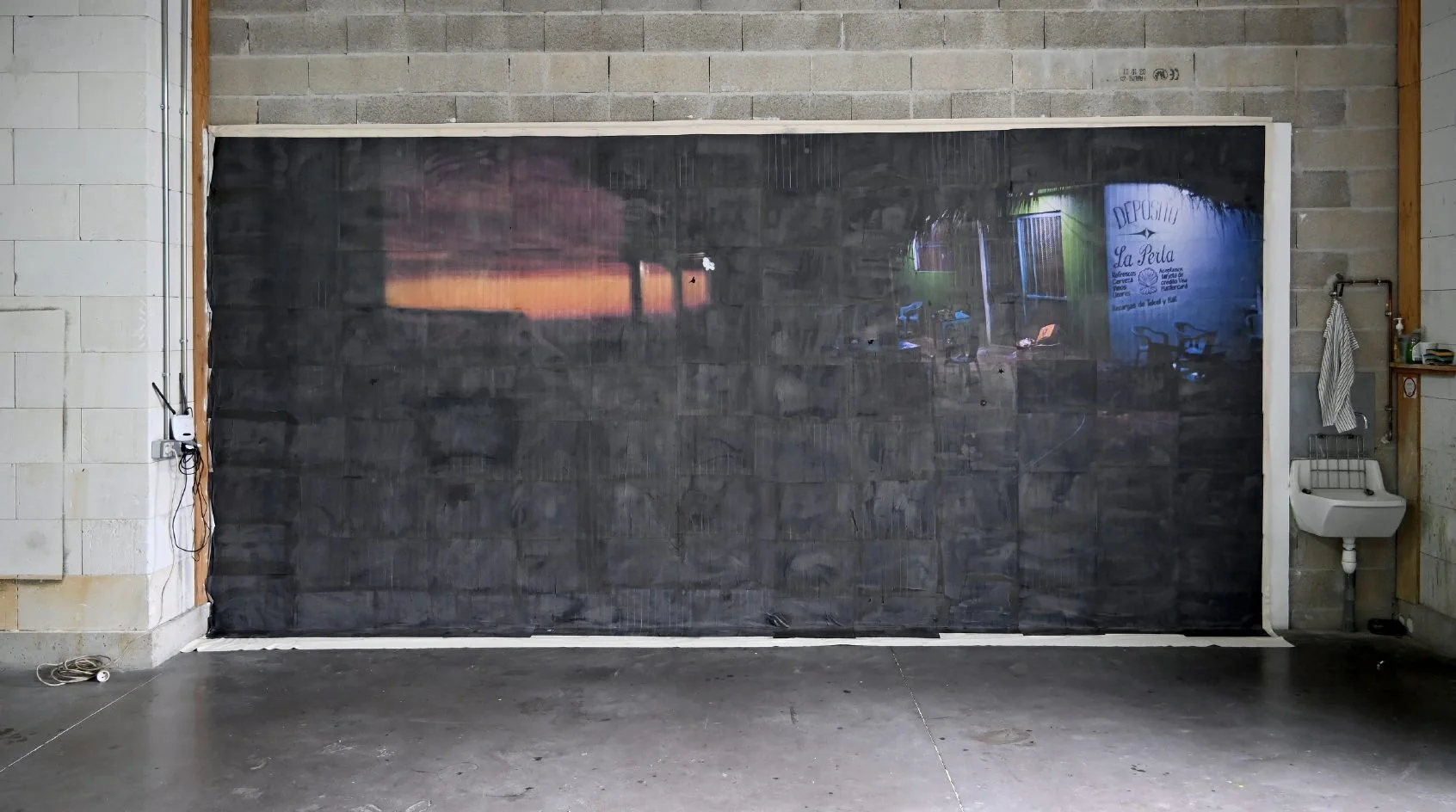
Image shared by Jennifer Lauren Martin.
My name is Jennifer Lauren Martin. I'm an artist, filmmaker, and writer, and Oreet had invited me to write a text that could possibly be included in the publication for her wider project, and that invitation came at a time that felt quite kismet to some things that I was trying to think through around the Mexican carpenter bee and a trip that I had taken to an Afro-Mexican village in Oaxaca.
This is a large-scale collage work that's called Black Bee, and it's very much a kind of test that emerged from my studio residency at Triangle Astérides in Marseille this winter. The collage is composed of two photographs that have been tile-printed on A3, wheat-pasted onto canvas, and worked into with oil pastel, graphite, and colour pencil. It’s 2.5 x 5m in height and length. Drawn in graphite and colour pencil, three bees are spread across the image.
The Mexican Carpenter bee, also known as Xylocopa mexicanorum or Xylocopa micans, can be found in Mexico, Guatemala and areas of the Gulf and Coastal regions of the Southeast US. They’re part of the species of large carpenter bees. The ‘mican’ of the name comes from the Latin micans, micantis, for to flash, gleam, beam, shine, be bright, which relates to the reflective quality of the bee. Their bodies are generally metallic black and reflect light with blue or green tinges.
I’ve been writing about grief and my paternal lineage, and about seeing a black bee for the first time in a place where I was trying to understand my ancestral connection, as my familial connection to Mexico is contested. I imagine the text will cover a lot around lineage, belonging to a given land and/or people, language, and desire. There’s a part I started writing about encountering a multilingual man in Marseille, who expressed something of the brutality of his reality, and wanting him to know I understood his French and that there was something we shared; I said, ‘Mi padre es mort’, mixing Spanish and French. He did not understand. I found myself repeating, ‘Mi padre est mort, mi padre est mort, mon père ha muerto.’ That’s all still to come, and what has emerged in a split from those initial plans, in making the collage work, and occupying space with it, and then, much later, much more recently, reflecting on what I might imagine of an audience’s encounter with this work, I landed somewhere else in the text, focusing primarily on a relationship to the images and memory of place, which I’ll read now.
BLACK BEE
If you’re looking at a photograph that I took from that time that I knew I was in love, but that every love has an end in its beginning and that that end was crashing down, readily with great speed and force, and you see metallic black bees that are and aren’t flying and resting on top of the paper of the image of the place in which I was in love, and you know that the Mexican Carpenter bee is that metallic black, and if I were to tell you that this place that I was in and not in love was CH****** where everything was black, even the squirrels, even the bees, would you want to run your hand over the wall to remind yourself of the paper and the perspective and permeance-in-wake of an image, not an unfolding reality,?
Would you think about that this isn’t reality? Would you think about the difference between the being and not being of the real? Would you think about the time that you were in love, but you felt it crashing down around you? Would you think about what makes a bee or any living thing metallic black? Would you think about what it would feel like to be surrounded by every living black being, not a thing, but being black (I only care if you are black)? Would you think about how sometimes you don’t want to remember? Or how you didn’t want to run your hands against the paper because you would prefer to keep open the possibility of the wind, and the halo of the light hanging overhead from the cabin’s porch, and that the sunset would set, and that the sunrise would rise, and the grains in the sand would stick either side of your toes and plough, turn in not up the earth, and that you would be in love still and surrounded by black.